Recent Comments
New Products
Warwickshire Ring (Combined)
Your opportunity to save a little money with
both the Popular and Bowcam DVDs together in one box at a lower price, and you save on postage too.
find out more
Caldon Canal (Combined)
Your opportunity to save a little money with both the Popular and Bowcam DVDs together in one box at a lower price, and you save on postage too.
find out more
Data Collection on the Grand Union Canal
Posted on Tuesday, 7 February 2012 at 15:13 Comments (0)
|
Cycling the short Hertford Union Canal completed the data collection for the London sections of the Grand Union Canal cruising maps. | ![]() |
Virtually straight from one end to the other the canal was constructed to provide a direct link between the Regents Canal and the River Lee Navigation which not only saved time but avoided the difficulties of a short trip along the tidal River Thames before the Limehouse Cut was dug. | ![]() |
For more information see | ![]() |
Continuing with the data collection for the Grand Union Cruising Maps I cycled the towpaths of the Regents Canal across the northern edge of central London. The Regents Canal runs from the junction with the Paddington Arm of the Grand Union Canal at Little Venice to the junction with the tidal River Thames at Limehouse Basin. | ![]() |
Neither of the two tunnels - Maida Vale Tunnel at 249m (272 yards) and Islington Tunnel at 878m (960 yards) - have towpaths requiring walkers to take the marked route over the top of the hills. | ![]() |
The canal passes through London Zoo, with some of the animals visible briefly, next to the market at Camden, and close to the main line stations at Kings Cross and St. Pancras. | ![]() |
For more information see | ![]() |
We've just released the next map in our Cruising Maps series. | ![]() |
No need to keep turning from one page to another in canal guide books to trace your way around the Cheshire Ring as the seamless Memory Map format is just what you have been waiting for. | ![]() |
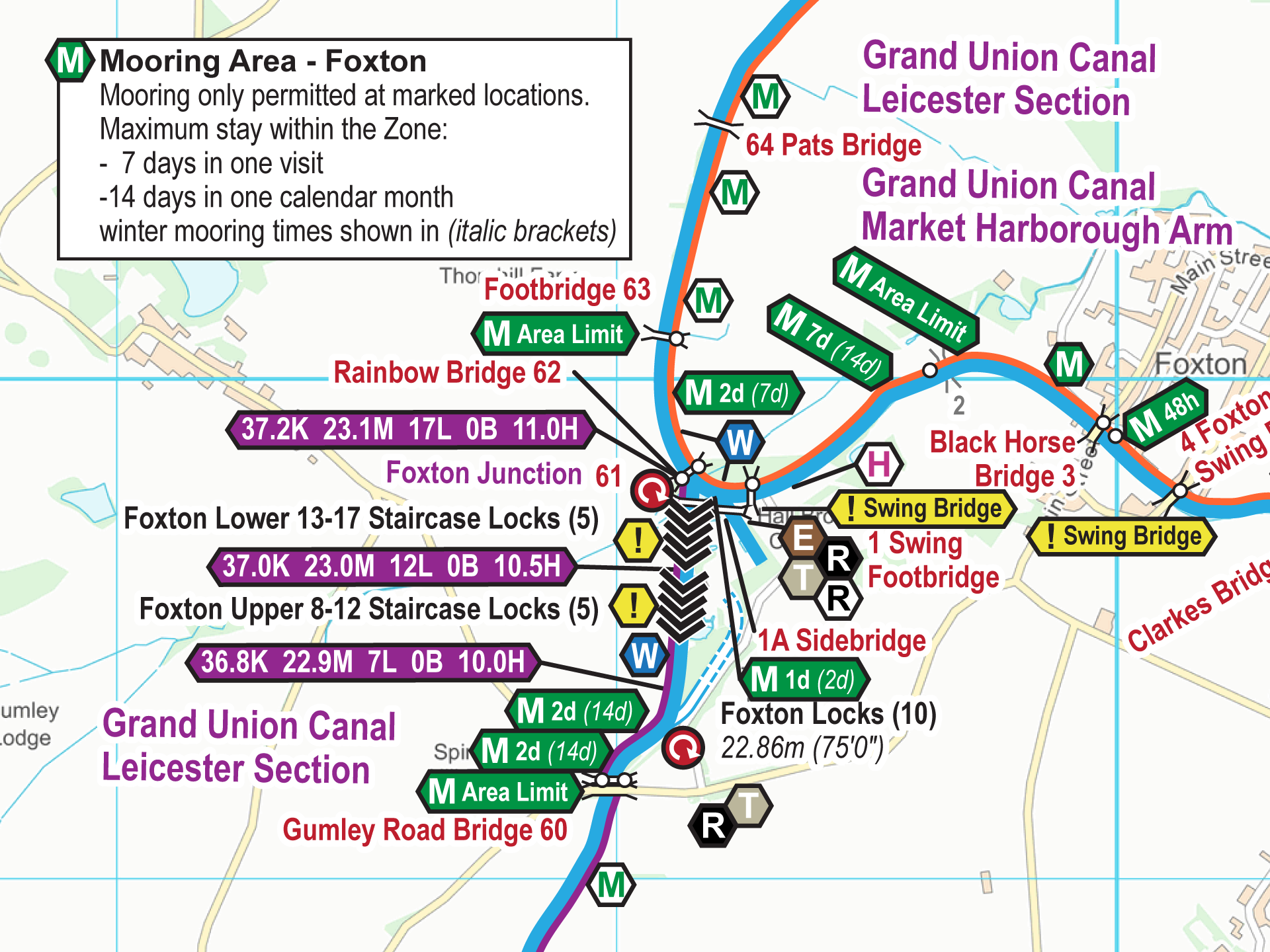
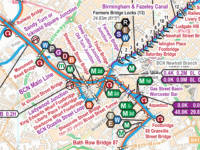
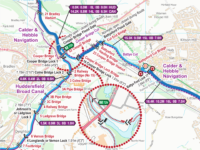
The second map on the right shows an extract from the Cruising Map (click to enlarge) | ![]() |
Last month I cycled along the Paddington Arm of the Grand Union Canal to collect data for the future releases of our Cruising Maps. | ![]() |
I headed east from Bull's Bridge Junction along the arm. Soon I discovered I wasn't cycling along the Paddington Arm, but along the Paddington Branch. So what is the difference? | ![]() |
There was nothing unexpected during the rest of the data collection ride. I now have all the water points, winding points, moorings etc. shown on the master map and ready for publication shortly. | ![]() |
Compared to the Aylesbury Arm which I recently tried to cycle along but ended up pushing my bike through the mud, the Slough Arm was a great improvement. | ![]() |
There was lots of mud and a few puddles but most of the arm had a hard surface just under the mud making it possible to cycle without much problem. | ![]() |
Collecting the data for our cruising maps was easy - first along the arm was Bridge 0. | ![]() |
The arm is almost straight, with very few features along its length, and can hardly be described as exiting or interesting. Even the end of the arm is an anti-climax - it just peters out in Slough, with a dead end, a pylon and a winding hole. | ![]() |
For more information see | ![]() |
In the last blog, about the Wendover Arm, I mentioned the Aylesbury Arm was next. | ![]() |
I've cycled along hundreds of kilometres during the last few months and found towpaths in various states of repair. The Aylesbury Arm is amongst the worst I have found and it's really quite wrong to say I cycled along the Arm - I pushed the bike most of the way as the mud was too much to cycle through. It wasn't just a few bad patches as on other canals - it was almost the whole arm. | ![]() |
Considering how many books and websites recommend routes along the arm I was surprised by what I found. Perhaps it's too many people walking which churns up the mud. I met several people clutching maps and walking books, and several of these had stopped to study the maps to see where else they could walk as they abandoned their attempts to walk along the Aylesbury Arm. | ![]() |
The arm starts with a two lock staircase and the flow of water along the arm as the locks are used is important, as the water is drawn from the precious resources on the summit level of the main line and goes to waste, as far as the canal is concerned, as it flows into the River Thame at the bottom, and on into the River Thames. | ![]() |
I measured the depth of all the locks, as I do along all the routes when I collect the map data, and the depths can be seen in the table of key features on the route information page. | ![]() |
Making the most of the reasonably warm weather recently I've been continuing to cycle the towpaths to collect the data for our growing range of Cruising Maps. | ![]() |
The Wendover Arm runs from Bulbourne Junction on the summit level of the Grand Union Canal main line into Wendover. | ![]() |
With considerable support from the Wendover Arm Trust, British Waterways, and many others, including volunteers, the remaining short navigable section of the arm was extended in 2003 to the current limit of navigation. | ![]() |
The dry section has seen more lorries than boats recently as the canal bed is used to transport concrete and other materials and equipment to the worksites. | ![]() |
The remaining section is still in water, albeit only 30cm (12 inches) deep in most places, but this doesn't require much effort to imagine boats cruising along the arm into Wendover. | ![]() |
We left Loughborough Basin early this morning, to make the most of the forecast early sunshine. There had been lots of heavy rain overnight and more forecast for this afternoon. Pillings Flood Lock took us by surprise as this normally has both sets of gates open in the summer but they were closed today and we had to work it as a conventional lock, with just 3 inches (75mm) difference in levels. | ![]() |
![]() | ![]() |
Barrow upon Soar looked great while the sun was out as we carefully navigated through the centre arch of the stone bridge an managed the sharp bend each side of the bridge. | ![]() |
![]() | ![]() |
Heading south this morning we reached Braunston Turn where we kept to the left towards Norton Junction. | ![]() |
![]() | ![]() |
We descended the paired locks at Hillmorton as we headed into Rugby. | ![]() |
![]() Another great pair of canal DVDs are released from Waterway Routes covering the Warwickshire Ring, clockwise from Braunston Turn. | ![]() |
![]() The Oxford Canal, with the paired locks at Hillmorton, completes our circuit of the Warwickshire Ring. | ![]() |
Thursday was another Hatton day. This time to help Derek & Dot on Gypsy Rover and Derek & Carrie on Uccello climb the locks. Arriving at Warwick Parkway station at 09:20 it was just a few minutes walk to the waiting cup of coffee on Gypsy Rover. | By 11:30 the rain had stopped and we were heading up the flight. Gypsy Rover leading the way most of the time, with Uccello close behind. |
![]() | ![]() |
![]() | ![]() |
I think I’ve more photos of Dot steering other peoples boats than steering Gypsy Rover. | ![]() |
Windsong » |
It was a trip on the train this morning to reach Northampton for a short walk down to the River Nene where No Problem was just arriving.
After spending summer on the rivers they were returning to the canal system for the winter and I was to help them work the 17 locks of the Rothersthorpe flight on the Northampton Branch of the Grand Union Canal.
There was just time for a little (or was it a lot of) shopping before leaving Northampton.
The first few locks near the town had anti vandal devices fitted. I’ve seen many variations before but these are the first I’ve seen fitted with a Yale key rather than a handcuff key. I assume it makes them harder for the vandals to get around.
With Sue and Vic taking turns steering and working the locks and with help from Anne (from Moore2Life) and from me, we managed the flight in reasonable time.
I left them at Gayton Junction, shortly after the top lock to walk to Milton Malsor for a bus to Northampton and to return home by train. Sue had already written her blog by the time I had returned home.
When we met Brian and Diana on Harnser very briefly last night we established we were both planning to descend Hatton Locks today and, being broad locks, we could share the work.
First I delivered another batch of our DVDs to the Canal Shop with time for a quick chat with Neil, then we were off. I walked through the separate footpath tunnel at Shrewley, to check it out for filming tomorrow and soon we were at the top of Hatton Locks.
Chatting happily together we were down the flight in 2 hours 25 minutes, and we would have been a little quicker if we hadn’t caught up slow moving boats near the bottom. Having a 5th crew member makes a lot of difference with one able to go ahead and set the next lock each time.
At the bottom we went into the Saltisford Arm for a pump out and found this moorhen sitting on 5 eggs and happily watching us right alongside. It even stood up so I could see the eggs.
We’re moored just outside the Saltisford Arm, which was already full with breasted up boats when we got there. Tomorrow we will be heading back up Hatton the Hatton flight as we film for one of our DVDs.
With severe weather warnings issued for heavy rain the prospects weren’t good for today. Sure enough the rain was heavy all night and still heavy this morning.
The forecast is for heavy rain for 4 or 5 days (and probably more) so there was no prospect of continuing our filming by waiting a day or two.
So, on with the waterproofs and off we head back to Sherborne Wharf in the rain and we’ll have to come back again later to complete the filming.
Unlike my last visit to Hatton Locks when there was a shortage of water while the locks were drained for maintenance, there was a surplus this time.
Lots of water flowing over the bywashes which use the former single locks left when the wide locks were installed in a modernisation scheme. Sometimes it just flowed in torrents over the gates as if it was winter rains we’d had.
We’re moored at Kingswood Junction ready to head up the Lapworth flight to reach our home mooring at Sherborne Wharf tomorrow or Monday.
With rain forecast for today we set off from Napton Junction intending to progress as far as we could until rain stopped play.
Much to our surprise it was great weather so we not only made it down all 23 broad locks, to the lowest pound of our journey, but up two locks at the other end.
There’s a 2 lock staircase at Bascote where the bottom lock was leaking so badly I wondered if the boats would get over the cill from the top lock.
Look at the water mark on the walls in the first photo and you’ll see it has gone down 6 inches (15 cm) in the time it has taken the boats to move half way from the top lock.
At Budbrooke Junction we turned very sharp left into the Saltisford Arm. We’ve never been down there before so we weren’t sure what to expect.
It started with a large "Welcome" sign on the bridge, then an arm with boats moored along both sides and a handily placed winding hole.
We received the warmest welcome we’ve received anywhere from the Saltisford Canal Trust who occupy the Arm. They have visitor moorings, a day hire boat, a canal shop an much more.
We winded and moored the boat, visited the supermarket and were all ready for tackling Hatton tomorrow if the weather permits – but the forecast is for heavy rain
We’re moored on the Saltisford Arm aiming for Hatton tomorrow, and possibly Knowle – or staying put if the weather is really awful.
We continued south today, climbing the three paired locks at Hillmorton. The locks were numbered from 2 to 7 which surprised me at first, until I remembered the stop lock at Hawkesbury Junction which must be number 1.
Then onwards again to reach Braunston Turn where we meet the Grand Union Canal from London to join the combined stretch to Napton Junction. Are we travelling South on the Oxford Canal or North on the Grand Union Canal?
There were lots of boats on the combined stretch and I was inside checking the maps to see how far we were going to get today when I glanced out of the front.
Passing us already was Derwent6, crewed by bloggers Del and Al. Not remembers their names on the spur of the moment I stuck my head quickly out of the front of the boat and shouted "Hello, fellow bloggers". Del looked very surprised for a moment but quickly checked the name of our boat and greeted us too.
He grabbed his camera and took a shot of us disappearing in the distance. I did likewise, and was able to retrieve one from our Bowcam showing them approaching.
I hope we get to exchange more than a few words next time we meet.
We’re moored at Napton Junction, hoping to get down most of the broad locks on the Grand Union tomorrow, then up Hatton on Saturday. Any visitors to help with the broad locks will be most welcome to share the work.
Bank holiday Monday was our first trip to the Canalway Cavalcade at Little Venice on the Grand Union Canal in London, near Paddington.
The weather was dull and overcast with occasional light showers, and not conducive to encouraging visitors to come out. The free entrance certainly could not have been putting anybody off attending.
Despite all that I was surprised at how few people there were around the site.
Lots of bunting on the boats and a few boaters around, but not many visitors.
Just look at the shots of the stands below. One with attentive stallholders waiting for customers but nobody even walking past – and I didn’t wait specially to catch a moment with nobody there.
At the bottom right the passers by aren’t even looking at the stand and the stallholder isn’t even trying to engage with the passers by. Hopefully it was better on other days when the sun shined.
I was travelling near the Hatton Locks of the Birmingham leg of the Grand Union Canal yesterday and paused to take some photographs.
One of the pounds had been drained while winter maintenance work was undertaken at the locks. It shows the profile of the canal bed clearly when the water is missing.
The Hatton flight was built with narrow locks which were replaced by broad locks in a 1930s improvement scheme.
That allowed boats to use the locks faster, particularly when the unpowered butty could come into the lock alongside the motor boat and they could pass through each lock in one go.
The remains of the narrow locks can be seen alongside the broad locks in most cases.
If you look at the close up of the broad lock then you can see the paddle exposed, which is normally hidden well under water. It’s only when the pounds are drained that you can see and photograph these.
Also visible is the vertical slot where stop planks can be inserted to allow just the lock to be drained. Their use allows just the lock to be drained quickly but restricts the working area and might be done for emergency work in the summer.
In the winter its usually easier to drain the whole pound which gives a larger working area and, as the locks are closed anyway nobody is disadvantaged by draining the pound – and that can be checked for problems at the same time.
After a day in London (doing some other work) I spent last night on our boat in Birmingham as a convenient staging post for today’s expedition.
An early start ensured I could catch Sue & Vic (and Lucy & Meg) on No Problem before they sneaked off shopping, walking or whatever.
It worked. After a brisk walk from Sileby station I found them they were exactly where I expected them to be.
We spent all morning chatting about all sorts of canal related topics from battery monitors to continuous moorers.
I was also introduced to Geoff (and Meg) from Seyella who had been sharing locks with No Problem recently and was moored just in front of them. Hopefully I’ll also meet Mags next time.
Somehow, Geoff knew about our DVDs already, which makes him a really good boater and blogger.